
Anesthesiologists Play a Critical Role, Before, During, and After Surgery

Pre-op
Diagnose underlying medical conditions and their impact on surgery, and determine whether the patient can safely undergo the procedure.

Intra-op
Provide appropriate anesthesia levels to maintain life functions during otherwise painful surgical procedures; medically diagnose, treat, and optimize medical emergencies and surgical problems that arise.

Post-op
Ensure continuity of physician-led medical care and pain management for a faster, less painful recovery, shorter hospital stays and reduced re-admissions.
Title Transparency: Know Who Is Providing Your Care
Anesthesia care is safest when patients know exactly who is caring for them. A physician anesthesiologist completes four years of medical school, followed by an internship and a residency in anesthesiology, and many go on to fellowship training in areas like pediatric anesthesia, cardiac anesthesia, or pain medicine. That depth of training is what allows a physician anesthesiologist to manage the full range of medical conditions a patient brings into the operating room.
As non-physician roles expand across healthcare, titles like “Dr.” and “-ologist” are increasingly used in ways that make it harder for patients to recognize that training. Californians see the problem clearly. Three in four say it can be misleading when the “Dr.” title is used by a provider who is not a physician, and 91 percent support a state informed consent law requiring transparency about a provider’s qualifications and title.
Patients have a right to know about the training and qualifications of the people caring for them. CSA supports clear title standards so every Californian can make an informed choice about their care.
Read the research: Californians Support Title Transparency to Protect Patient Safety (PDF)
Provide Safe and Effective Multi-Modal Pain Management
Anesthesiologists and pain medicine specialists are on the front lines of fighting the opioid epidemic.
They are leading experts in utilizing non-opioid pain medicine options including interventional procedures and non-pharmacological approaches.
They work with patients to implement tailored pain management plans to ensure optimal recovery.
Increase Efficiency & Reduce Healthcare Costs
Physician involvement can reduce costs by avoiding over-utilization of tests, over-prescribing medications, and excess referrals to specialists.
Save Lives & Improve Health Outcomes
Physician Anesthesiologists
- 20% reduction in adverse events with physician led care
- 50x fewer deaths due to physician anesthesiologist efforts
Certified Registered Nurse Anesthetists (CRNAs)
- 35% higher anesthesia mortality rate when nurse anesthetists practice without physician supervision.
Ensure Oversight & Lead the Care Team
Some healthcare facilities use an Anesthesia Care Team made up of multiple providers under the leadership of anesthesiologists:
Physicians (MDs) – Leaders of the Care Team
- Anesthesiologist
- Anesthesiology Fellow
- Anesthesiology Resident
Non-Physicians – Members of the Care Team
- Certified Anesthesiology Assistant
- Certified Registered Nurse Anesthetist (CRNA)
- Student Nurse Anesthetist
- Student Anesthesiology Assistant
- Medical School Student
Mandatory Training
Physician Anesthesiologist
- 12-14 years of education after high school
- 12,000-16,000 hours of clinical training
Certified Registered Nurse Anesthetist (CRNA)
- Total of 5-7 years of education after high school
- Median of 1,651 hours of clinical training

Patients want Physician-led Care
A survey conducted by the American Medical Association found that:
- 91% of respondents said that a physician’s years of medical education and training are vital to optimal patient care, especially in the event of a complication or medical emergency.
- 86% of respondents said that patients with one or more chronic diseases benefit when a physician leads the primary health care team.
- 84% of respondents said that they prefer a physician to have primary responsibility for the diagnosis and management of their health care.
Anesthesiologists On the Front Lines of COVID-19
Anesthesiologists have been leaders in the heroic response by our nation’s healthcare providers to fight the COVID-19 pandemic and save lives. To address immediate needs in hospitals and other healthcare settings, anesthesiologists’ role as specialized physicians expanded from perioperative and pain medicine to emergency response, critical care, and crisis management.
The Critical Role of Anesthesiologists During COVID-19
- Leading specialized COVID airway intubation teams.
- Flexing into critical care settings.
- Working with hospital administrators on creative approaches to expand capacity and prepare for surges.
- Creating consensus-based guidance.
- Facilitating the sharing of best practices for the treatment of this novel disease.
- Contributing to information management and data tracking.
- Facing personal risk in the pursuit of patient care
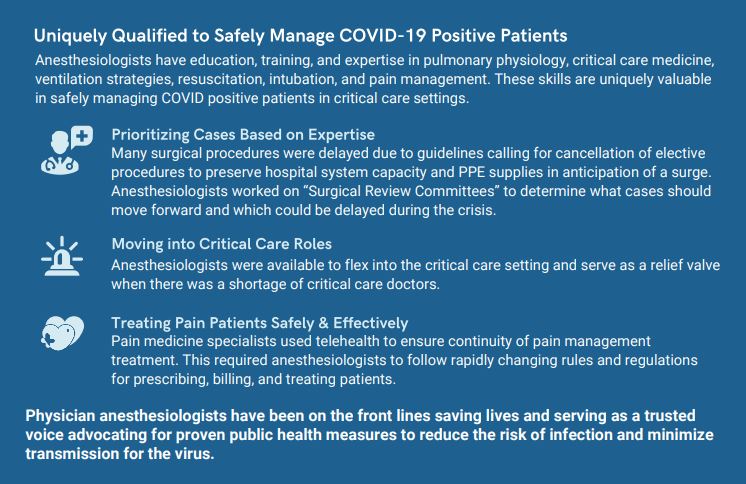
Uniquely Qualified to Safely Manage COVID-19 Positive Patients
Anesthesiologists have education, training, and expertise in pulmonary physiology, critical care medicine, ventilation strategies, resuscitation, intubation, and pain management. These skills are uniquely valuable in safely managing COVID positive patients in critical care settings.

Prioritizing cases based on expertise
Many surgical procedures were delayed due to guidelines calling for cancellation of elective procedures to preserve hospital system capacity and PPE supplies in anticipation of a surge. Anesthesiologists worked on “Surgical Review Committees” to determine what cases should move forward and which could be delayed during the crisis.

Moving into critical care roles
When hospitals faced a shortage of critical care doctors, anesthesiologists stepped in to help care for patients in intensive care units.

Treating Pain Patients Safely & Effectively
Pain medicine specialists used telehealth to ensure continuity of pain management treatment. This required anesthesiologists to follow rapidly changing rules and regulations for prescribing, billing, and treating patients.
Physician anesthesiologists have been on the front lines saving lives and serving as a trusted voice advocating for proven public health measures to reduce the risk of infection and minimize transmission for the virus.
Download COVID-19 Visual