By Christian Bohringer, MBBS
Ketamine is a phencyclidine derivative that was first synthesized in 1962. It is an NMDA receptor antagonist and has profound benefits for treating both pain and depression. Recently it has also been recommended as a treatment for posttraumatic stress disorder.
Despite its potential for addiction and its status as a schedule III drug, ketamine is being increasingly marketed to the public as a mind-expanding medication that is perfect for helping people get in touch with their “true inner selves”. Using ketamine as a medium to experience “horizon-broadening transformational new sensations” and to encounter the “spirit world” is however very dangerous. Observational studies in frequent high-dose (>1g/day) ketamine users show impairment of memory and executive functions. (1) The cognitive defects reported in chronic recreational ketamine users include difficulty with verbal and visual memory, as well as problems with impulse inhibition and reasoning. This executive dysfunction was significantly associated with dropout from residential treatment centers in ketamine users within three months. (2)
Ketamine therefore needs to be recognized as a very powerful psychoactive medication that should only be prescribed for significant medical problems such as chronic pain or substantial psychological illness. Ideally its use should be authorized by a licensed pain physician, an anesthesiologist or a psychiatrist.
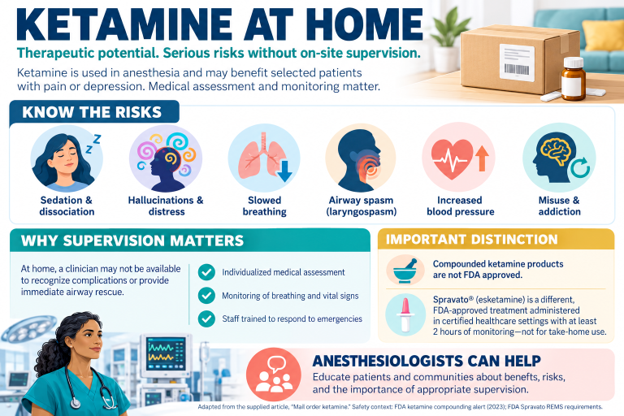
Anesthesiologists have more practical experience with this drug than most other physicians. We should therefore educate the community about the risks of laryngospasm, dysphoria, and hallucinations associated with this drug. These side effects can be readily managed when this medication is administered under skilled medical supervision. Laryngospasm can however lead to serious harm and death when this drug is ingested at home without a clinician who can immediately treat airway obstruction. Ketamine infusion clinics have therefore been established at psychiatrist offices that are staffed by anesthesiologists who monitor respiration and treat any episode of airway obstruction immediately. This environment offers appropriate safety precautions but adds to the cost of the treatment. This money is however well spent. When psychedelic doses of ketamine are administered in a clinic without staff who are competent in airway resuscitation this represents a significant safety hazard and the customers of these clinics need to be made aware of the risk.
Companies like Mindbloom and Joyous are now sending ketamine preparations directly to people’s homes for consumption in an environment that does not provide immediate access to airway resuscitation by a skilled clinician. The preprocedure health evaluation of these telehealth clinic customers is usually incomplete because a physical examination that can elicit signs of valvular heart disease or congestive cardiac failure is not possible.
Ketamine undergoes extensive first pass metabolism in the liver and preparations for home consumption therefore come in the form of subcutaneous injection, as sublingual lozenges or as a nasal spray. Customers pay out of pocket for the “Ketamine Experience” anywhere from US $129 per month to US$230 per dose. The strength of the dose is individualized for each specific customer, and the dose range is not disclosed in the informational material accessible to the public. While Joyous is advocating lower doses to provide a psycholytic journey, Mindbloom offers higher doses to provide the full-blown psychedelic experience. When mail-order ketamine is consumed by people in the privacy of their own home without supervision, there is also nothing to stop a person struggling with substance use disorder from consuming multiple lozenges or nasal sprays all at once.
The direct-to-consumer business model of sending ketamine straight to users’ homes remains very controversial. Many physicians deplore that the Drug Enforcement Agency (DEA) is not stopping this aggressive marketing and proliferation of an addictive substance. Ketamine continues to be used commonly as a party drug at “Rave” dance parties and has been associated with heat strokes in young people during these events. It is also commonly used as a drug to facilitate sexual assault.
While ketamine depresses respiration less than opioid drugs, the risk of laryngospasm is real. Deaths have occurred when this drug was taken together with other substances. The death of Matthew Perry is a well-publicized recent example of this. Mindbloom has been involved in a wrongful death lawsuit in North Carolina with the toxicology report showing a ketamine concentration of 9.3mg/L in the blood of the deceased. Several wrongful death and personal injury lawsuits have been filed against other mail order ketamine companies alleging negligent practices that resulted in death, injury and sexual assaults. These lawsuits are still in the early stages of discovery. Interestingly, the two mail order ketamine start-ups “Nue Life” and “Noma” were closed after financial difficulties, and their consumer programs were disbanded.
Legal action over ketamine has also taken place after paramedics unintentionally killed a citizen with an overdose while they were trying to assist police. (3)
Owners and operators of these mail order “Ketamine Mills” are usually not physicians but have a background in business or in the allied health professions.
While nobody can deny the powerful beneficial effects of ketamine for patients suffering with pain and depression, when used appropriately with proper medical supervision, I believe that American society currently underestimates the risk of laryngospasm, catecholamine surges, and addiction that is associated with this medication. As anesthesiologists we should educate the community about the true ramifications of misusing this drug because we are more familiar with it than most other physicians. Disseminating our knowledge will help the citizens of our country make educated decisions about the indications for taking this drug and the environment in which they are prepared to ingest this substance.
References:
- Li SW, Kumpf KT, Urrutia J, Krystal JH, Sanacora G, Wilkinson ST. Ketamine for Depression, but at What Cost? A Review of Ketamine’s Neurotoxic Effects From Preclinical and Human Studies. Am J Psychiatry. 2025 Oct 1;182(10):903-912. doi: 10.1176/appi.ajp.20250276. Epub 2025 Sep 10. PMID: 40926573.
- Zhang C, Xu Y, Zhang B, Hao W, Tang WK. Cognitive impairment in chronic ketamine abusers. Psychiatry Res. 2020 Sep;291:113206. doi: 10.1016/j.psychres.2020.113206. Epub 2020 Jun 8. PMID: 32763531.
- https://opmed.doximity.com/articles/medication-was-designed-to-treat-not-harm?_csrf_attempted=yesho