
By Fahim Mahmud, MD
The CSA Committee on the History of Anesthesia congratulates the 2nd place winner of the CSA 2026 History of Anesthesia Essay Contest: Fahim Mahmud, MD, author of “From Los Angeles to Copenhagen: An Anesthesiologist’s Battle Against Polio Launches Critical Care Medicine.”
Dr. Mahmud, originally from Boston, is a CA-2 resident physician at UCLA. He completed his undergraduate degree in English at Brown University before moving to California for medical school and staying for residency. He enjoys combining his passion for medicine with his love of reading and history.
The COVID-19 pandemic propelled critical care medicine to the forefront of societal awareness. Faced with dire circumstances, anesthesiologists across the globe innovated, from establishing virtual ICUs to developing protocols for intubation and proning.1 As experts in airway management and resuscitation, anesthesiologists have been natural leaders in numerous public health catastrophes. During the mid-twentieth century poliomyelitis epidemic, the work of renowned Danish anesthesiologist Bjørn Ibsen and his colleagues marked a pivotal turning point that directly shaped this development.
Many associate polio with the widespread use of the iron lung, a cylindrical device with an airtight collar that generated negative pressure to facilitate lung expansion.2 This revolutionary machine saved countless polio patients but had several drawbacks: limiting access to the patient’s body, causing discomfort, pulling respiratory secretions into the airway, and requiring a patent natural airway to ventilate patients.3
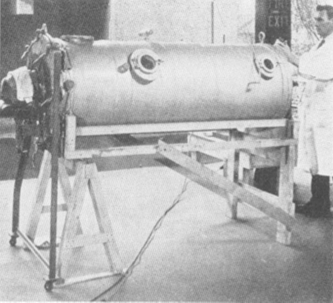
Original ‘iron lung’ with a patient inside. Reproduced from the Journal of Clinical Investigation 1929;7:229-47.4
In the late 1940s, Albert Bower, Chief of Los Angeles County Hospital’s Communicable Disease Service, observed that bulbar polio patients in iron lungs were unable to overcome upper airway muscle weakness. Bower consulted biomedical engineer Vivian Ray Bennet, who had founded a ventilator company that assisted World War I pilots with oxygen delivery. The two collaborated on “the Bennett positive pressure respirator attachment,” which worked with the iron lung’s negative-pressure feature, simultaneously pushing air into the patient’s lungs.5 Furthermore, while the arrival of a nurse with a bedpan was previously associated with the fear of apnea when the iron lung would be opened, patients now had a bridge with positive-pressure ventilation (PPV) alone.6
The Danish polio epidemic began in August 1952, with cases of terminal bulbar polio skyrocketing. Copenhagen’s infectious disease center, the Blegdam Hospital—armed with seven modified iron lungs—served as the primary battleground. At the time, most physicians believed that mortality resulted from overwhelming infection of the brain causing irreversible injury. Blegdam’s chief, Henry Cai Alexander Lassen, reluctantly consulted Bjørn Ibsen despite his low status as a staff anesthesiologist who lacked a permanent hospital position.6
Ibsen had been studying reprints of the PPV articles from Los Angeles. He was convinced that bulbar polio patients suffered from progressive hypercapnia rather than irreversible brain injury. The patients’ blood showed elevated CO2 levels, conventionally thought to represent a metabolic alkalosis. Ibsen, however, argued that the high CO2 content resulted from hypoventilation causing retention, indicating a primary respiratory acidosis. Ibsen knew from the OR that he could provide large, steady breaths using only positive pressure and deemed the iron lung insufficient for resolving the acidosis.3, 6
On August 26, 1952, 12-year-old Vivi Ebert was admitted to the Blegdam with ostensibly fatal bulbar polio. Lassen allowed the eccentric Ibsen to trial his ideology on Vivi in an essentially all-or-nothing demonstration.6
Believing Vivi’s frail constitution would not survive sedation, Ibsen made the mistake of administering only local anesthetic for her tracheostomy. Vivi’s struggling caused excessive bleeding into her lungs. Armed with a Waters to-and-fro breathing circuit, Ibsen futilely attempted to ventilate her, as she was now suffering from bronchospasm.6
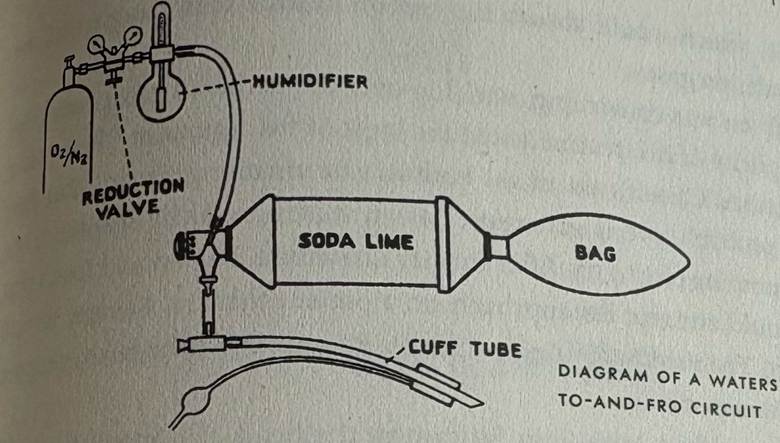
The Waters to-and-fro circuit.6
Onlookers left in disappointment as nurses urged Ibsen to cease his experiment. Ibsen then made the bold decision to administer 100mg of sodium thiopental to relax Vivi’s body and airway. Suddenly, her vital signs improved, as her body warmed and returned to life. Exhilarated, Ibsen sought to prove his point by reverting to the “old approach.” He repeatedly interrupted sedation and manual PPV by putting Vivi into an iron lung, where she would promptly desaturate and become hypercapnic. She was subsequently rescued with Pentothal and PPV.3, 6
The next day, chemist Poul Astrup applied a modified version of Copenhagen manufacturer A/S Radiometer’s pH electrode—a device initially intended to measure the acidity of beer—to a bulbar polio patient’s blood, confirming Ibsen’s theory of a life-threatening acidosis. Thus emerged the first rapid arterial blood gas (ABG) device.7
Lassen immediately ordered that Ibsen’s technique be used on all Blegdam polio patients with respiratory failure; however, without automated ventilators, the six anesthesiologists in Copenhagen were quickly overwhelmed. The Blegdam turned to hundreds of medical students, who took heroic shifts manually bagging the patients.3, 6 With information from Astrup’s new ABG device, they were taught how to alter the frequency (respiratory rate) and intensity (tidal volume) of bag-squeezing to alter minute ventilation. Mortality rates miraculously dropped from 90% to below 25%.8
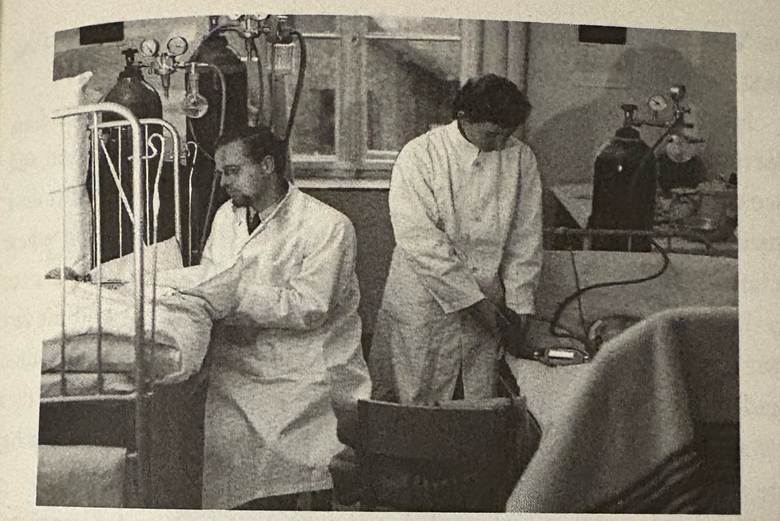
Ventilation of patients by medical students at the Blegdam Hospital, 1952.6
On May 9, 1953, Ibsen was again consulted when a 10-year-old boy arrived to the Blegdam with tetanus’ pathognomonic risus sardonicus. While polio patients did not necessarily require sedation and never required pharmacologic paralysis, Ibsen now saw the possible synergy of both modalities alongside mechanical ventilation.6 He anesthetized the boy with 50% N2O and paralyzed him with d-tubocurarine chloride. Doctors checked daily to see if they could cease these radical therapies, but the boy was too ill and required treatment for seventeen days. He developed many complications, from pressure wounds to infections, yet he survived. This method for protracted PPV spread throughout Europe, extending to non-infectious pathologies in which adequate natural ventilation was lost.6
Ibsen was not done; he had a vision for anesthesiologists outside of the OR. He saw the benefit of the constant monitoring and record-keeping in the OR and proposed enforcing the same guidelines on ward patients in various shock states. He endeavored to create a special hospital location for only the critically ill—those who required mechanical ventilation for respiratory failure and regular monitoring of ABGs, alongside the expertise of specialized physicians, nurses, and pharmacists. He received permission to admit patients to the first “intensive therapy unit” under the direct care of an anesthesiologist. While the idea of triaging the sickest to one area was not novel, pairing them with critical care experts and mechanical support was.6
Just as with COVID-19, the polio epidemic stole countless lives, yet created a legacy that has supported the intensive care of countless individuals. While polio has been almost completely eradicated, the contributions of those who braved the deadly virus live on in perpetuity—in every mechanically supported breath of ICU patients across the globe.
References
1. Anesthesiologists Are Innovators and Problem-Solvers. American Society of Anesthesiologists. Accessed December 26, 2025. https://madeforthismoment.asahq.org/innovation/
2. Drinker P, Shaw LA.An apparatus for the prolonged administration of artificial respiration: I. A Design for Adults and Children. J Clin Invest. 1929;7(2):229-247. doi:10.1172/JCI100226
3. Takala J. A History of Intensive Care Medicine. In: Eger II EI, Saidman LJ, Westhorpe RN, eds. The Wondrous Story of Anesthesia. Springer; 2014:785-798
4. Meyer JA. A practical mechanical respirator, 1929: the “iron lung”. Ann Thorac Surg. 1990;50(3):490-493. doi:10.1016/0003-4975(90)90508-4
5. Bower AG, Bennet VR, Dillon JB, Axelrod B. Investigation on the care and treatment of poliomyelitis patients. Ann West Med Surg. 1950;4(10):
6. Wunsch H. The Autumn Ghost. Greystone Books Ltd; 2023.
7. Severinghaus JW, Astrup P, Murray JF. Blood gas analysis and critical care medicine. Am J Respir Crit Care Med. 1998;157(4 Pt 2):S114-S122. doi:10.1164/ajrccm.157.4.nhlb1-9
8. West JB. The physiological challenges of the 1952 Copenhagen poliomyelitis epidemic and a renaissance in clinical respiratory physiology. J Appl Physiol (1985). 2005;99(2):424-432. doi:10.1152/japplphysiol.00184.2005